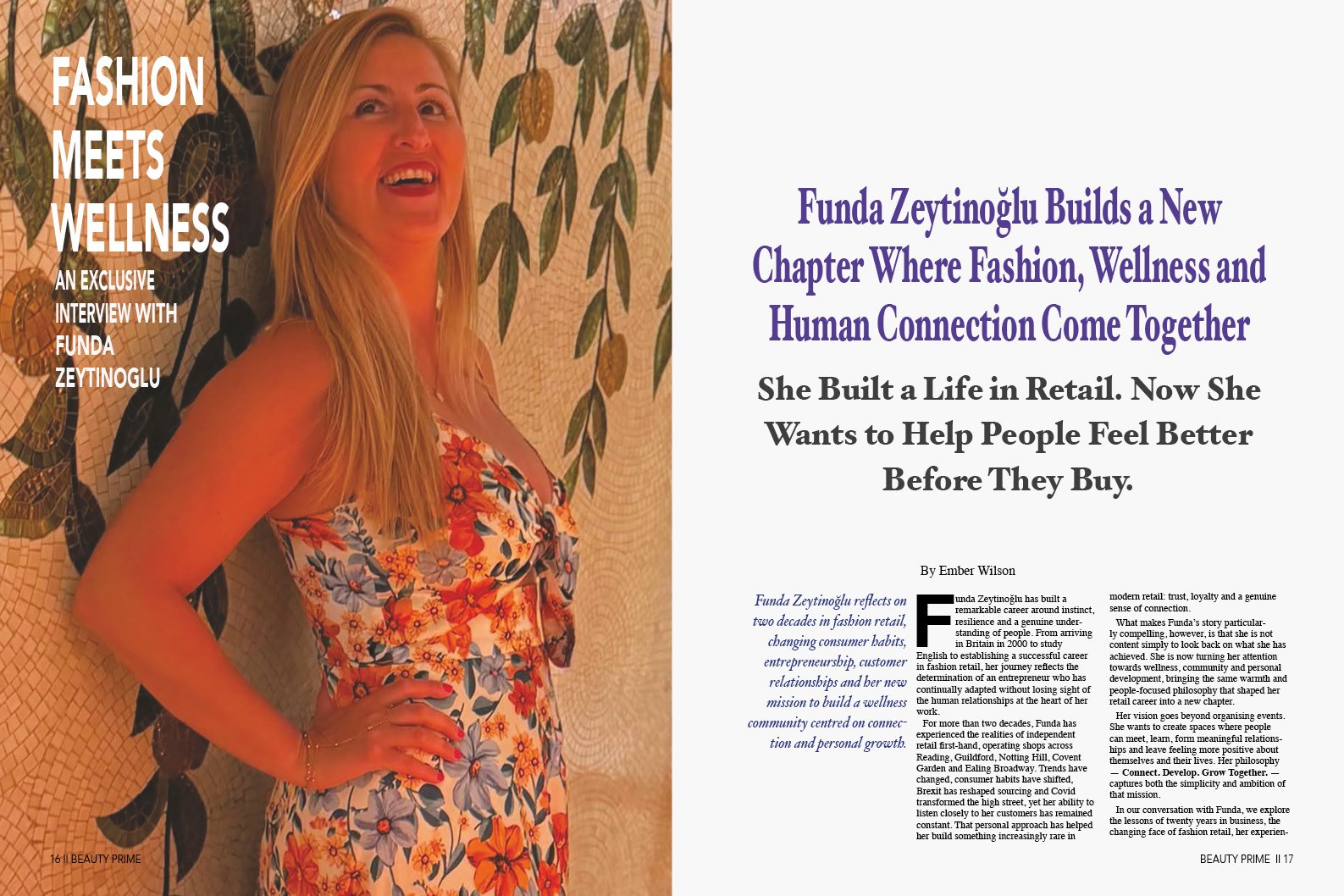


She Built a Life in Retail. Now She Wants to Help People Feel Better Before They Buy
Funda Zeytinoğlu reflects on two decades in fashion retail, changing consumer habits, entrepreneurship, customer relationships and her new mission to build a wellness community centred on connection and personal growth.
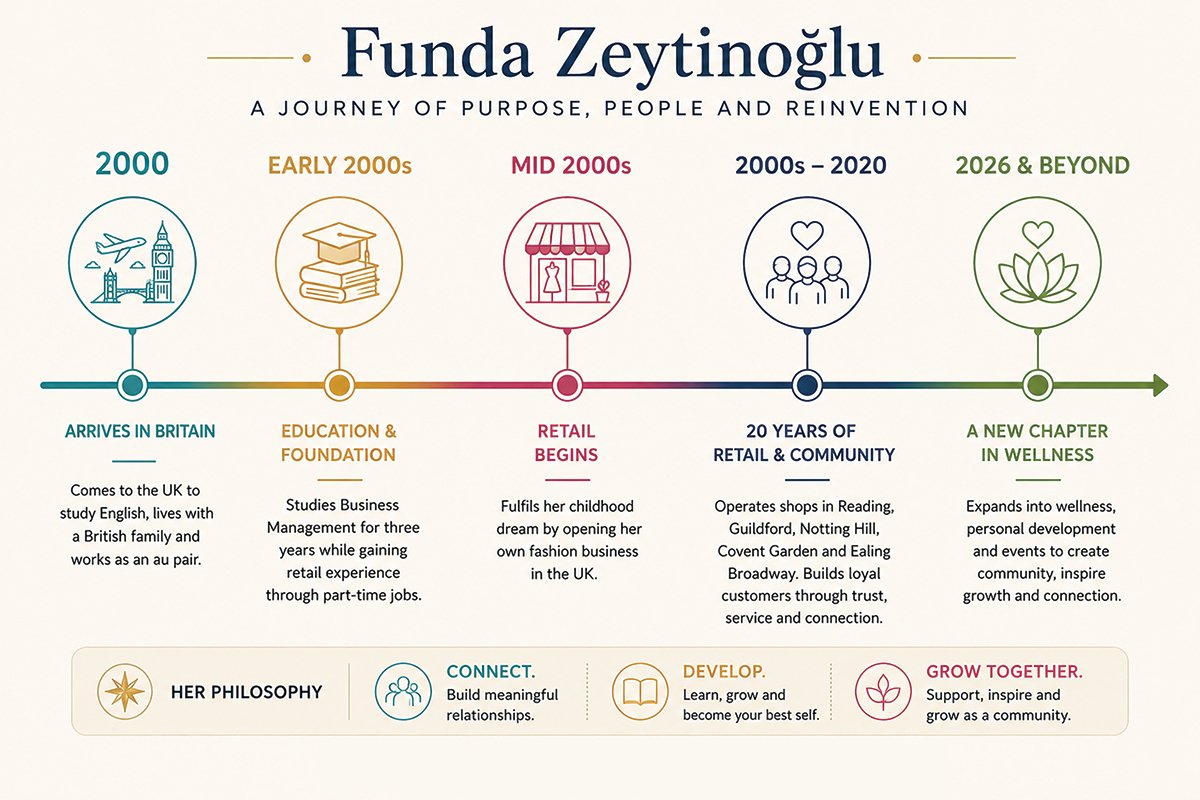
F unda Zeytinoğlu has built a remarkable career around instinct, resilience and a genuine understanding of people. From arriving in Britain in 2000 to study English to establishing a successful career in fashion retail, her journey reflects the determination of an entrepreneur who has continually adapted without losing sight of the human relationships at the heart of her work.
For more than two decades, Funda has experienced the realities of independent retail first-hand, operating shops across Reading, Guildford, Notting Hill, Covent Garden and Ealing Broadway. Trends have changed, consumer habits have shifted, Brexit has reshaped sourcing and Covid transformed the high street, yet her ability to listen closely to her customers has remained constant. That personal approach has helped her build something increasingly rare in modern retail: trust, loyalty and a genuine sense of connection.
What makes Funda’s story particularly compelling, however, is that she is not content simply to look back on what she has achieved. She is now turning her attention towards wellness, community and personal development, bringing the same warmth and people-focused philosophy that shaped her retail career into a new chapter.
Her vision goes beyond organising events. She wants to create spaces where people can meet, learn, form meaningful relationships and leave feeling more positive about themselves and their lives. Her philosophy — Connect. Develop. Grow Together. — captures both the simplicity and ambition of that mission.
In our conversation with Funda, we explore the lessons of twenty years in business, the changing face of fashion retail, her experiences working internationally, the importance of human connection and her evolving vision for wellness.
Funda Zeytinoğlu’s journey is ultimately one of reinvention with purpose — proof that success is not only about building businesses, but also about creating experiences, relationships and communities that leave a lasting impact.
Could you tell us a little about yourself and your story of coming to the UK?
I was born in Eskişehir in 1978. I came to the UK in 2000 to study English. When I first arrived, I lived with a British family and worked as an au pair for around two years. At the same time, I was studying English and also working part-time.
During this period, I learned about the retail business. I had the opportunity to work both for Turkish businesses and alongside people from different nationalities. I later decided to go to university and studied Business Management for three years.
After university, I wanted to establish my own business and make use of the experience I had gained through my part-time jobs. In fact, ever since I was a child, I had dreamed of having my own shop and selling clothes. Eventually, I made that dream a reality.
I have been in retail for around twenty years. During that time, I have had four or five different shops, operating in areas including Reading, Guildford, Notting Hill, Covent Garden and Ealing Broadway.
Before Covid, I had to close some of my shops. Today, I continue with my main store in Reading, which I opened twenty years ago.
Highlights
- Arrived in Britain in 2000 to study English.
- Began her UK journey living with a British family and working as an au pair.
- Studied Business Management before establishing her own retail business.
- Has spent approximately 20 years in independent fashion retail.
- Operated shops in Reading, Guildford, Notting Hill, Covent Garden and Ealing Broadway.
- Her Reading shop has remained at the heart of her business for around two decades.
- Credits customer loyalty and personalised service as major reasons for her longevity.
- Believes independent retailers can compete by offering experiences online shopping cannot replicate.
- No longer buys primarily according to fashion trends, preferring to understand what her customers actually want.
- Worked with suppliers and manufacturers across France, Italy, Thailand and Turkiye.
- Helped develop a manufacturing project in Turkiye connected with a company operating more than 170 Debenhams concessions.
- Says trust, professionalism and shared vision are essential to international business.
- Is now expanding beyond fashion into wellness, personal development and events.
- Wants her events to combine wellness, learning, entertainment and social connection.
- Her philosophy is “Connect. Develop. Grow Together.”
- Sees events not as the final product, but as a way of creating a lasting community.
- Measures success through relationships, feedback and positive change rather than attendance numbers alone.
- Wants people to leave her events feeling better, more motivated and more connected.
When you compare retail before and after Covid, what do you think have been the biggest changes?
Before Covid, online shopping was nowhere near as widespread as it is today. People would go out, visit shops and make their purchases in person. Covid changed those habits very quickly. People became accustomed to staying at home, while technology also developed rapidly.
During this period, major stores, chains and many independent boutiques closed. Today, there are very few independent boutiques like mine left in Reading. One of the main reasons I have been able to remain in business is the loyal customer base we have built by being here for twenty years.
Under today’s conditions, opening a new shop and managing to survive is genuinely not easy.
Online sales increased significantly after Covid. However, there is an opportunity within every crisis. If you are different, if you are doing something original and if you can offer customers a personalised experience, you can create an advantage for yourself.
One of our greatest strengths is customer service. People do not come into our shop simply to buy something. Sometimes, the shop almost becomes a form of therapy for them. They talk about their personal lives and feel that they are being listened to and understood.
We have had customers who have spoken to me or members of my team about problems in their lives and then said, “Thank you so much for listening to me.” Some have even become emotional and cried.
Over time, we realised that some people come shopping when they are unhappy. They may be having problems with their partner, or they may be unhappy with something in their own lives. They come into the shop, talk, feel better and then shop.
Now I want to take this to another level. One of the reasons I am moving into wellness is that I want to help people feel better about themselves first, and then I want them to shop because they are happy.
How closely do you follow fashion trends? How important are trends to you today?
I used to follow trends very closely. I would go out in the morning and visit all the major chain stores to see what was selling, which products were standing out, and which colours and styles were fashionable.
But after a while, I stopped doing that and, interestingly, my business actually began to perform better.
Over time, I realised that we had developed our own style and our own customer profile. Today, I no longer choose products according to trends; I choose them according to what my customers genuinely want.
We ask our customers, “What are you looking for?” and “What kind of thing would you like?” As a result, some of the products in our shop may not necessarily be the most fashionable pieces of the season, but they meet the needs of our customers.
There were times in the past when I brought very fashionable products into the shop, but they did not sell as well as I had expected. That is why today I place much greater importance on what the customer actually wants when selecting products.
Can customers request a particular product from you? For example, if they are looking for a specific dress, do you try to find it for them?
Of course. A customer can tell us what kind of product they are looking for, and we try to find something that suits the style, design or particular need they have described.
Looking back over your twenty years in retail, is there a customer or sales story that you have never forgotten?
There is actually one experience that happened to me twice in a similar way and taught me an important lesson in life.
One day, a woman came into the shop. Without trying anything on, she began taking five or ten items at a time from the rails, placing them beside the till, and then going back to collect more.
After a while, an incredible number of items had accumulated around the till. To be honest, I could not understand what she was doing. I asked her, rather firmly, “Are you really going to buy all of these?”
She said, “Yes, I am.”
But I still found it difficult to believe because she had practically collected half of the shop. In the end, she really did buy everything.
She told me she was going to take the products back to her country. I remember that she came from an Arab country. Perhaps she was going to sell them there; I do not know.
That experience showed me just how wrong prejudice can be. Once again, I learned that we should never judge people based on their appearance.
Later, I experienced a similar situation for a second time. Of course, from a business owner’s point of view, suddenly selling a significant proportion of the stock in the shop was also an extremely happy moment.
Turkiye is a very strong country in textile manufacturing. Despite this, why do you think there are relatively few major Turkish fashion brands with a truly global presence?
I think there are several reasons, and people who do business with Turkiye can sometimes see them.
One of the most important issues is vision. Some businesses in Turkiye may prioritise short-term profit rather than building a brand for the long term. The mentality of, “How much can I make from this customer today?” can sometimes take priority over developing a long-term relationship.
Of course, there are also excellent companies with strong vision. When you meet the right people, you can achieve very good things together. As with many things in life, working with the right people in business leads to success.
However, in my personal experience, I have encountered some problems involving pricing, promises not being kept and delivery times.
Was there a particularly memorable business experience you had while working with Turkiye?
There was an important project that I worked on for many years. I was trying to persuade my wholesalers in Turkiye to sell their products to a major retail chain in the UK.
Eventually, I convinced a very large Turkish supplier to work with Debenhams, which at the time was one of the UK’s most important department store chains. Debenhams had more than 170 branches.
We travelled to Turkiye together and visited the factory. Every detail, from the zips to the fabrics, was selected individually. A very large order was placed.
However, during production, the wrong size chart was used. Instead of using the measurements required for the UK market, the garments were produced according to Turkish sizing standards.
This created a major problem. The people at Debenhams experienced serious difficulties because of this mistake, and confidence in the project was damaged.
One of the things that disappointed me most was that there was not enough responsibility taken after the mistake. There was quite a casual attitude along the lines of, “Sorry, the person cutting the sizes mixed them up.”
But in a project of that scale, such an error needed to be treated much more seriously.
I also experienced problems with delivery times from time to time. For example, a delivery that was promised within two weeks could end up taking considerably longer.
Nevertheless, I do not view everything negatively. I believe that very successful business can be done with Turkiye when you work with the right people.
Was establishing a business connected to Turkiye actually an important goal for you?
Yes. One of my dreams was to build a business connected to Turkiye.
I particularly wanted to do this within the textile industry. I was having products manufactured in Turkiye, bringing them to the UK and selling them to wholesalers.
However, as I mentioned earlier, over time I experienced some issues regarding trust.
Having lived in the UK for many years, I became accustomed to the business culture here. Sometimes a person’s word can be as valuable as a written agreement. In Turkiye, however, I encountered several situations in which things that had been promised were not delivered.
After a while, this becomes exhausting. Because if you do not share the same vision, as in any relationship, it becomes difficult for a business relationship to continue successfully in the long term.
Where did you source your products from in the past?
Before Covid—or, more accurately, before Brexit—I used to travel to France very frequently. Almost every month, I would make a day trip or stay overnight in Paris.
I would do my buying, spend some time exploring Paris and then return to the UK the following day. It was a very enjoyable period.
Paris is one of Europe’s major centres for fashion wholesale. Many products are distributed from there to different countries across Europe. Buying directly from Paris was therefore also more advantageous in terms of price.
Which countries did you source products from apart from France?
I also brought products in from Italy, Thailand and Turkiye.
Before Brexit, sourcing products from Europe was much easier. After Covid, with the number of shops also declining, the whole system changed.
Today, I source most of my products from wholesalers in London. They import products from different countries around the world.
It can be slightly more expensive than buying directly from overseas, but operationally it is much easier and more convenient.
What role does your team play in the day-to-day running of the shop?
I have a very good team. This business is entirely about teamwork. It is simply not possible to achieve genuine success completely on your own.
The people on my team are very strong when it comes to human relationships. They listen to customers, understand them, genuinely hear what they are saying and are willing to help.
Because of that, I no longer need to be in the shop all the time. I trust my team.
I am now directing some of my energy towards the projects and events I want to develop in the wellness sector. I also want to achieve new successes in this area.
You mentioned that you have new projects outside the textile industry. How did your decision to move into wellness come about?
At some point in life, you begin asking yourself, “Why am I here? What is my purpose in life?”
For many years, I believed that my purpose was to do business and succeed in the textile industry. At that stage of my life, that genuinely was my purpose.
But after reaching a certain age, I experienced a number of realisations and changes. I wanted the transformations I had experienced in my own life to benefit other people as well.
I am beginning to organise events so that I can share the things I have learned and introduce people to valuable experts whom I have had the opportunity to meet.
Our first event will take place on 24 October. İlker Çağlayan will be joining us. He is a nutritionist, author, entrepreneur and educator. We are planning to organise a wonderful event together.
What is your main objective with these events? Who would you like to reach?
We want to reach people who are looking to make changes in their lives.
I want to organise events for people who want to live a better-quality, happier and calmer life; for those interested in healthy living; and for those who aspire to become the best version of themselves.
In short, anyone who wants to develop themselves can benefit from these events.
If you are saying, “I want to reach a better place in my life and become the best version of myself,” then these events are for you.
Does your interest in retail go all the way back to your childhood?
Yes. When I was at secondary school, Benetton had just arrived in Turkiye, and I desperately wanted to work in one of their shops.
I used to talk about it constantly with my family. Thankfully, my family was financially comfortable, and they did not want me to work at that age. They preferred me to focus on my education. Of course, from their perspective, they were right.
But looking back today, I believe it is extremely valuable for a young person to experience working life from an early age.
Working gives you life experience, builds confidence and provides valuable experience that can help you achieve your own dreams.
I think it can be very beneficial to encourage young people when they have this kind of desire.
Can we say that you fulfilled your childhood dream after coming to the UK?
Absolutely.
When I came to London, I already knew that this was what I wanted to do. I had always had that desire inside me—to open my own shop.
What is your main purpose in organising wellness events?
My main aim is to create a community where people can feel that they belong, build genuine connections and grow together. Particularly in the UK, where loneliness can sometimes be felt very intensely, I think it is incredibly meaningful to create a space where people with similar values can find one another.
The common ground does not mean that everyone has to think in exactly the same way. What matters to me is bringing together people who share values such as being open-minded, wanting to learn, developing themselves, sharing, contributing to others and having good intentions.
I can summarise the purpose of these events in three expressions: Connect. Develop. Grow Together.
Are you aiming for something more than people simply attending your events and spending a few hours there?
Absolutely. I want much more than people simply coming to an event, socialising for a few hours and then going home. Over time, I want to create an environment where they can say, “There are people here who understand me.”
I want new friendships and genuine relationships to develop. One person may learn something new, another may find the courage to make a change in their life, while someone else may meet exactly the person they needed at that particular moment in their life.
As the events continue, I dream of creating a circle of people who genuinely get to know one another, support one another and grow together.
How important is building a community to you?
It is extremely important. In fact, I do not see these events simply as one-day experiences. For me, the event itself is not the ultimate purpose; it is a vehicle. The real objective is to build a community.
The events will become meeting points where that community comes together, where people discover one another and where new connections are formed.
I want to create a genuine community in which people who are curious about similar things and share similar values can find one another and want to meet again over time.
What would you like people to take away from your events?
I want them to leave having experienced, learned or discovered something. Perhaps they will recognise something about themselves that they had never noticed before. Perhaps they will discover an activity they have never tried, or perhaps they will meet new people.
Most importantly, I want them to feel that the time they have set aside for themselves has genuinely done them good.
It would mean a great deal to me if they left the event feeling slightly better, more motivated and perhaps able to look at their lives from a different perspective.
Why do you want to bring wellness and entertainment together?
Because I do not believe wellness always has to be very serious or entirely inward-looking.
Taking care of yourself also includes moving, laughing, trying new things, meeting new people and having fun. I want to create a balance between these two sides.
I do not see wellness simply as turning inward; I see it as discovering, learning, connecting and enjoying life.
What kind of activities will feature at your events?
There could be movement, breathwork, mindfulness, creative workshops, talks and more social activities that people can participate in together.
I want to offer different experiences at each event. It is important to me that people are not simply passive listeners but active participants in the experience.
My aim is to create a programme where people can learn, discover new things and also enjoy themselves.
What will distinguish your events from a traditional wellness event?
I do not want to focus on just one area. I am not imagining a traditional event format where people simply practise yoga or sit and listen to talks.
I want to create an environment where people are actively involved in the experience. At one moment, you might have time to yourself, while at another you could meet someone new and laugh together.
I want to bring wellness, learning, socialising and entertainment together within the same experience.
What kind of atmosphere are you hoping to create?
I want to create a warm and welcoming atmosphere where people do not feel any pressure when they arrive.
You do not need to know a great deal about the wellness world. You may never have attended an event like this before. You can also come on your own.
My aim is to create an environment where people feel comfortable—something warm, engaging and inviting that encourages participation.
What will distinguish you from other event organisers?
I do not simply want to organise an event. I want to create an atmosphere and an experience that people will continue talking about and remembering after the event has finished.
I pay great attention to detail and to how people feel. For me, it is not only about what is included in the programme, but also about the emotions people experience while taking part in it.
I want people to leave saying, “That was a genuinely wonderful experience.”
Does being new to this field frighten you?
I am aware that, because I am new to this area, there is a great deal for me to learn. However, I do not see that as a disadvantage.
On the contrary, I believe that being able to look at the sector with fresh eyes and introduce different ideas that may not have been tried before can be an advantage.
Every new venture involves a learning process. I am very open to learning and developing myself throughout this journey.
How will you judge whether an event has been successful?
Attendance is, of course, important. However, for me, success is not measured simply by how many people attend.
The feedback people give afterwards, the energy created in the room, the connections that are formed and whether people want to return for the next event are much more important indicators of success.
If someone makes even a small positive change in their life after an event, makes a new friend or discovers something new about themselves, I would consider that an important success.
Where would you like to see this project in the long term?
Over time, I would like it to develop into a platform with different concepts and activities—something people follow regularly and where they look forward to the next gathering.
I want people to attend not simply for a particular activity, but because they want to be part of the experience and the community we are creating.
In the long term, I want to build a strong community of people who know one another, support one another, learn together and grow together.
For me, the essence of it is actually very simple: Connect, develop and grow together.
Click image to see print edition